Oct 20, 2026
by Jay Campbell
S01E42: The Blueprint Behind Every Enterprise SaaS Deal I've Won.
The short answer
The blueprint behind every enterprise SaaS deal I’ve won. Run an honest forecast with AI in three prompts, then get the full playbook: Deal OS.

This Week in AI Sales
Aligned put an AI agent inside the deal room. Seller Agent, announced October 14th, updates the mutual action plan and builds decks inside the space your buyer reads. Every change links to its source and waits for the rep's approval. Hold any AI that writes where a buyer can see it to that bar.
Claude can build a live dashboard of your Salesforce pipeline. Claude Dashboards went into beta on paid plans October 8th. It counts whatever reps typed into the CRM, so run this week's honest forecast before you trust the total.
GPT-6 is rolling out to ChatGPT Business. OpenAI's release notes date it October 7th. If your company runs on ChatGPT Business, the model under your saved prompts just changed, so rerun the one you rely on most against an old transcript before you trust it again.
Let's begin
I have a quick exercise for you. Open the biggest deal in your forecast and find the Economic Buyer field. Now find the call, and the minute in that call, where the buyer told you who signs.
If you cant, that field probably got filled in on a Friday afternoon from memory... and it counts toward your number the same as a fact does.
I built DealIQ OS around this exact problem. It pulled MEDDPICC out of call transcripts and scored every deal against a stage ladder with 28 exit criteria. Then I rebuilt that method to run inside the AI you already use. It's called Deal OS, and it's out today.
The idea underneath it is simple: a deal with no buyer evidence behind it should forecast at a quarter of its weighted value, and earn the rest back one buyer quote at a time.
So this week, the honest forecast by hand in three steps. Then what's inside Deal OS.
Why the Weighted Forecast Fails
A weighted forecast multiplies the deal amount by the stage's win probability. The problem is what puts a deal in a stage. In most CRMs it's a drag and drop, and nothing checks whether the economic buyer has been on a call or whether anyone named a decision date.
So the forecast counts what the rep believes: "Economic buyer: engaged" with nothing behind it, or a claim you made that the buyer answered with "Okay," now sitting in the business case as their number.
Discount Every Deal by What the Buyer Confirmed
Honest forecast = amount x win probability x (0.25 + 0.75 x evidence)Evidence is the average of two numbers.
Coverage: how many of the eight MEDDPICC letters the buyer confirmed, as a percent.
Exit completion: how many of the current stage's exit criteria a call has proved, as a percent.
(MEDDPICC, if it's new to you, is the eight things a B2B deal needs on the record: Metrics, Economic Buyer, Decision Criteria, Decision Process, Paper Process, Identify Pain, Champion and Competition.)
A deal with no evidence keeps a quarter of its weighted value. A deal with full evidence keeps all of it. And every honest number prints its reasons next to it, so you know what to go fix.
Step 1: Every MEDDPICC Letter, Marked by the Buyer's Own Words
Attach every call transcript from the deal and run this. It's prompt 4 of the 14 in Deal OS, exactly as it ships. It mentions a Company File, which you wont have yet, and it works fine without one.
Review this deal against MEDDPICC. The transcript is attached or pasted below. If I have more than one call on this deal, every transcript is attached. My Company File is attached too, if I filled one in. Use only those files. Today's date is the date of this chat. If you cannot tell it, ask me before you write anything. Make a table with one row for each letter: Metrics, Economic Buyer, Decision Criteria, Decision Process, Paper Process, Identify Pain, Champion, Competition. The columns are Letter, State, Evidence and Question.
- State: CONFIRMED, MENTIONED or UNKNOWN. - CONFIRMED: the buyer said it in their own words. - MENTIONED: it came up, but the buyer did not confirm it. Or only I said it. Or the buyer guessed, hedged or promised to act. - UNKNOWN: nobody covered it.
- Evidence: the timestamps of the buyer's lines behind the state, like [12:41], or NONE.
- Question: the one question I should ask to move the letter up one state. A CONFIRMED letter needs none, so write None. A letter is CONFIRMED only when the buyer, in their own words:
- Metrics: gives a number they measure today, such as a volume, a cycle time or a cost. A target alone is MENTIONED.
- Economic Buyer: names the person who controls the budget or gives the final yes.
- Decision Criteria: says what they will use to choose.
- Decision Process: names the steps from here to signature and when the decision happens. Steps or people with no dates are MENTIONED.
- Paper Process: names at least one paper step (legal review, security review, procurement or signature) and the team or person who runs it. The other steps can come on later calls: every step mapped with an owner and a date is a Stage 4 check, not this letter. A step with no one named to run it is MENTIONED.
- Identify Pain: describes the problem and what it costs or breaks.
- Champion: describes something that person did for me, such as introducing someone, forwarding my material or selling it inside. A promise to act is MENTIONED.
- Competition: names the alternatives: another vendor, a tool they already own, or doing nothing. Be strict. If I said it and the buyer did not confirm it, it is MENTIONED at most. A nod such as Okay, sure or makes sense is not a confirmation. Quote marks hold only the buyer's exact words, copied exactly as the transcript spells them. Then give me:
1. Coverage: how many of the 8 letters are CONFIRMED, written as N of 8.
2. The Champion Test, for the person most likely to be my champion. Name them. Answer each question Yes or No, with the buyer's quote and its timestamp or an act with its date. A yes you cannot point to counts as a no. A question the transcript cannot answer is a no. - Would they fight for this if I disappeared? - Do they return my calls and emails quickly? - Have they introduced me to others? - Do they share internal information? - Are they selling this internally? Two or more no answers means I do not have a true champion yet. Say so.
3. The single biggest risk in this deal, in one sentence. If my Company File lists Disqualifiers and the transcript shows one, that is the biggest risk. Then give the one action that reduces it, with an owner and a date. The owner is me unless someone on the call took it. The date is today or later and is written out with the year.
It's stricter than the version in S01E33: a nod, a promise to act or a decision process with no dates doesnt count. Read two CONFIRMED rows
against the transcript before you trust the rest.
Your number: coverage, CONFIRMED letters out of 8.
Step 2: The Exit Criteria, Proved or Open
Use your company's exit criteria for the stage the deal is in. No written ones? Start with Deal OS's four for Discovery: six of eight MEDDPICC letters confirmed, three pain quotes with timestamps, one metric with today's number, and the next meeting booked with an agreed agenda.
Check this deal against the exit criteria below. Every call transcript
from the deal is attached. Use only those and what I write here. Exit criteria:
[PASTE THEM] Things that happened off a call, each with its date:
[For example: "Demo booked by email on October 6, 2026." Or NONE] Mark each criterion:
- MET: a buyer line on a call proves it. Give the speaker and the timestamp. My own lines never prove anything.
- ATTESTED: it happened off a call and I gave you the date. No date, no ATTESTED.
- OPEN: anything else. Then give me exit completion (MET out of the total, as a percent, with
ATTESTED left out) and, for each OPEN criterion, the one action that
clears it, with an owner and a date written out with its year.
ATTESTED moves the stage and never the forecast.
Your number: exit completion, MET criteria out of the total.
Step 3: The Honest Forecast, With the Drag Reasons
Here is my forecast, one row per deal:
Deal | Amount | CRM win probability | MEDDPICC letters CONFIRMED (of 8) | Exit criteria MET (of total)
[PASTE ROWS] Using code, never mental math, work out for each deal:
evidence = the average of (CONFIRMED / 8) and (MET / total)
weighted = amount x win probability
honest = weighted x (0.25 + 0.75 x evidence) Give me a table: Deal, Weighted, Honest, Gap, and Drag reasons in plain
words, like "3 of 8 MEDDPICC letters confirmed". Biggest gap first, with
totals at the bottom.
On the two made-up example deals that ship with Deal OS, the weighted pipeline said $75,120 and the honest one said $55,084. Northwind, a $48,000 deal in Stage 2 with 3 of 8 letters confirmed and no call in 26 days, went from $18,240 to $8,869.
Here's that run as it sits in the Deal OS guide, unedited:

Why This Works
Only the buyer can raise the number. Your notes and a CRM drag and drop leave it where it was. A buyer quote with a timestamp moves it.
The drag reasons are your Monday list. "1 of 4 stage criteria proved by a call" tells you which call to book.
What went wrong building it. Every Deal OS skill ran word for word in a fresh Claude session against checks written before it ran. The failure that kept coming back was this issue's whole point: a skill credited the Solutions Consultant's line "Forty-seven of the fifty read correctly."
to the buyer. It showed up in three different skills before the fixes held. The final pass ran 249 checks across two deals, and all 249 passed.
Still unsettled. The 12 skills have only been tested in Claude, not ChatGPT, Gemini or Copilot, and the guide says so.
What's Inside Deal OS
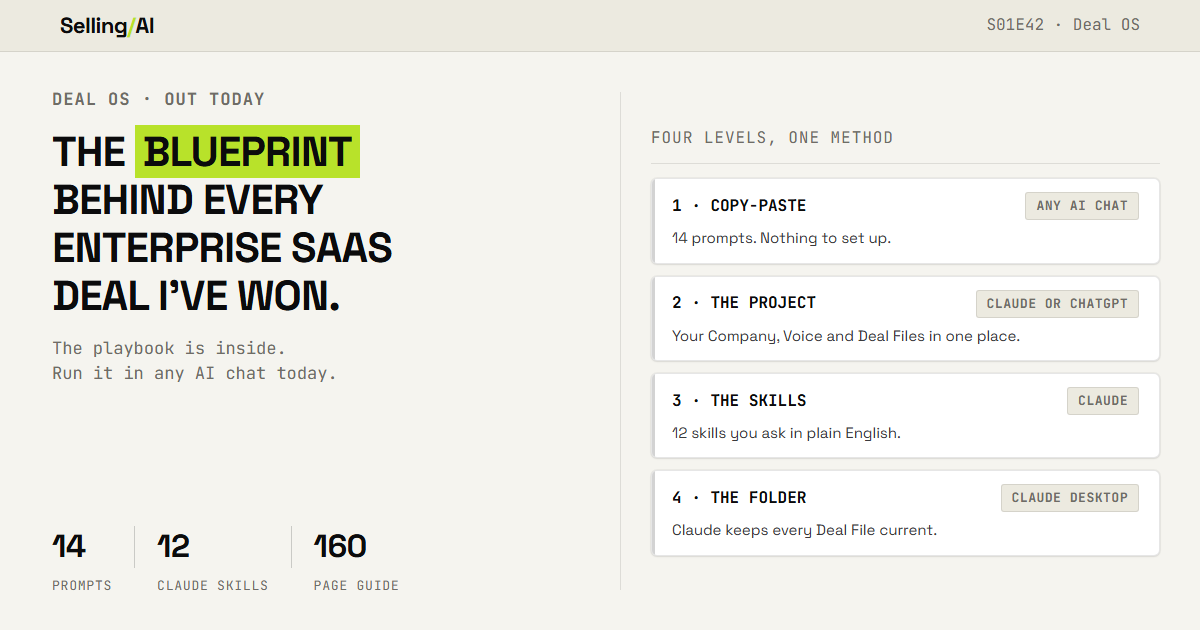
That was one prompt and two worksheets. Deal OS is the whole system, at whatever level you're at with AI.

A 160-page guide. Part 1 is the method with no AI at all.
14 prompts and 12 Claude skills, from account recon to close-out.
A Company File and a Voice File, filled in once, so every draft knows what you sell and sounds like you.
A Deal File for every deal that ties each fact to the call it came from.
A worked example: one made-up deal across three calls, every output unedited.
Not sure where to start? Attach GIVE-THIS-TO-YOUR-AI.md to a new chat and type "Onboard me." It finds your level and sets you up.
Deal OS is out today. It's $34 through November 30, then $79.
Rep Action this week
Run the honest forecast on your three biggest deals before your next forecast call. Step 1 and Step 2 for each deal, then Step 3 once with all three rows.
And one question, because the answer decides what I write next... which level are you? Hit reply with 1, 2, 3 or 4. Whichever number comes back most, next week's issue walks through that level step by step.
~ Jay
The free section gets you the honest number. The Vault gets three more pieces of Deal OS that run on their own.
This week in the Vault:
The Send Check. Paste any draft headed to a buyer or your manager and get every line that fails, with the fix.
The Champion Test, in Full. Five questions answered from the record, the champion forward email, and the red flags.
The Stage Check. Every exit criterion from Discovery to Closed, and the prompt that tells you the stage a deal has actually earned.
Members get every Vault drop plus the full back library. $20/mo, or $140/yr and save $100.
Click here for the stack I’d build today: https://www.sellingwithai.vip/stack

You just read the motion. Now run it.
The prompts, checklists, and templates that turn this into a 10-minute execution are in the Vault.
Vault access includes:
- Copy and paste execution prompt packs
- Deal, outbound, and follow-up playbooks
- Operating checklists for every motion
- Members Vault access
