Aug 18, 2026
by Jay Campbell
S01E33: I Have ADHD. Every Deal I Won Was Won by a System.
Every system I ever built exists because I knew I would forget.
The short answer
Most reps fill in the deal record the night before the forecast call, which means reconstructing it from memory instead of qualifying anything. Here is the four-step post-call system that fills the record from what the buyer actually said, plus the six checks that catch the deals already gone wrong. Prompts included.

Let’s begin
I never lose my car keys.
Theres a little cubby on my dresser. Thats where they go. Every day, the same cubby, and it happens without me deciding to do it, because it happens at the same moment I empty my pockets at the end of the day.
I’m opening a sales newsletter with a story about keys because that cubby is most of the reason I've had a career. I’m being serious.
I have ADHD. For real, like full blown.
For most of my life I’ve called it a superpower, and inside a room it genuinely is one. I read people well. I catch what somebody's face does about a half second before they decide to say the polite version. I self-correct mid-sentence. I can explain something down to a level of detail most people dont have the patience to sit through. And I was persuasive enough to close more than I didnt.
All of that is real, and I still have it.
What took me a long time to see is that every one of those things only works inside the room, and none of them survive it.
Whatever it is that reads your economic buyer's face doesnt write anything down. It doesnt move a close date. It doesnt remember, eleven days later, that he said "we'd probably want legal to look at this" in a throwaway half sentence at minute 41, while you were already thinking about your next question.
I never trusted myself to remember any of it, and that wasnt discipline talking. I knew I would forget, because I always did.
So I built systems instead. Notes, then templates, then prompts, then actual software. Ive always been a systems builder, not because it came naturally, but instead because I had to. I would have never been successful in sales otherwise.
The clearest version of that is when I inherited a $22M national accounts book and took it to $48M in 22 months, and I was automating my outbound the entire time.
Im not traditionally good at sales. But I am very good at systems.
I know how that reads. I mean it flatly. Many of you reading this are probably better in a room than I ever was. What I had instead was that I never once assumed I would remember the thing I needed on Thursday, so it went somewhere the moment it existed.
This issue is that, made repeatable. It runs about ten minutes a call.
Why Remembering Fails
Ask a rep when they update the deal record and you get a version of the same answer every time. Before the forecast call.
Thats the whole problem, and it has nothing to do with being lazy.
When you fill in the record the night before a forecast call, you aren’t qualifying anything. You’re reconstructing. The call happened nine days ago. What you’ve got left is a general feeling that it went well, whatever survived into short term memory, and a strong preference for this deal being real, because you’ve already told your manager about it twice.
The audience changed too. A record you fill in during the deal has one reader, you, and it exists to show you where you are weak. A record you fill in for the forecast call has a different reader, and it gets written to survive the review. Its the same eight fields either way, doing a completely different job.
Thats how a deal ends up with an economic buyer field containing a name you’ve never spoken to. Nobody lies on purpose. Somebody said a name once, you typed it into the field two weeks later because the field wanted a name, and from that moment it stopped being something you heard and became something your company believes.
And I want to be clear that I’m not describing an ADHD problem here. I’m describing what memory is. Mine gave out faster and more obviously than most, which turned out to be the only real advantage I had. I found out early that I couldn’t run a book of business out of my own head. Everybody else gets to keep believing they can, right up until a deal walks over something the buyer told them in week two.
Give Every Fact One Place
The keys have a cubby, which is a different thing from me having a rule about being careful with keys. A rule would need me to be on top of things that particular day. The cubby doesn’t care what kind of day I’m having, and thats the difference the whole issue turns on.
So every fact a deal produces needs one place it goes, the same place every time, and it has to get there in the moment it exists rather than whenever you next feel organized. Thats not a discipline problem you can fix by caring more about it. I tried that version for about a decade and it lost to a busy Tuesday every time.
The reason this is possible now and wasn’t in 2019 is that the expensive part used to be the capture. Writing down what was said, structuring it, deciding which of the eight elements it belonged to, drafting the follow up. That was forty minutes of work after every call, which is why nobody did it, which is why the record was always a reconstruction.
That part is now four prompts and about ten minutes. Heres the sequence I run.

Step 1: Capture What Was Said, Not What You Took From It (2 minutes)
Record the call. Fireflies, Gong, Granola, the recorder built into whatever you already run meetings in. Im not going to argue about the tool, because the tool isnt the point.
The point is the two minutes right after, while the transcript is still open.
You pull quotes. Not a summary, the actual sentences your buyer said, in their words, with a timestamp on each one.
You are a transcript analyst. You do not summarize and you do not interpret. Here is the transcript of a sales call: [PASTE TRANSCRIPT] Pull every direct statement the BUYER made about any of the following:
- money (budget, cost, what they spend today, who controls it)
- timing (dates, deadlines, events they are working back from)
- process (steps, approvals, legal, security, procurement)
- people (names, titles, who decides, who objects)
- the problem (what is broken, what it costs them, what they tried) For each one, return exactly three things:
1. The quote, word for word, no cleanup
2. The timestamp
3. Which of the five categories it belongs to Rules:
- Quote only. If you find yourself writing a sentence the buyer did not say, stop.
- Do not include anything I said. My words are not evidence.
- If a category has nothing in it, write "nothing said" and move on. Do not reach for the closest thing.
- Ambiguous or half-finished sentences still count. Include them as-is and mark them [UNCLEAR]. Those are usually the important ones.
The reason this comes first, before any framework, is that a summary is already an interpretation. The moment you summarize, you lose the ability to tell later which part the buyer actually said and which part you concluded on the drive home. The quote survives a forecast call. The summary is the thing you end up arguing about.
That last rule earns its place more often than you would think. "We'd probably want legal to look at this" is a half sentence nobody writes down, and it is the entire reason a deal slips a quarter.
Step 2: Score It Against the Methodology (5 minutes)
We ran MEDDPICC, so thats what I built this on. Use whatever your team actually runs. The mechanics dont change.
This takes the quotes from step one and sorts them into the framework. The part that matters is what it does when a quote doesnt exist.
You are a deal qualification analyst working under one hard constraint: a field is only filled if a buyer quote supports it. Here are the quotes from my last call, with timestamps: [PASTE THE OUTPUT FROM STEP 1] Here is what was already on the record before this call: [PASTE, OR WRITE "NOTHING"] Map the quotes onto MEDDPICC. For each of the eight elements return:
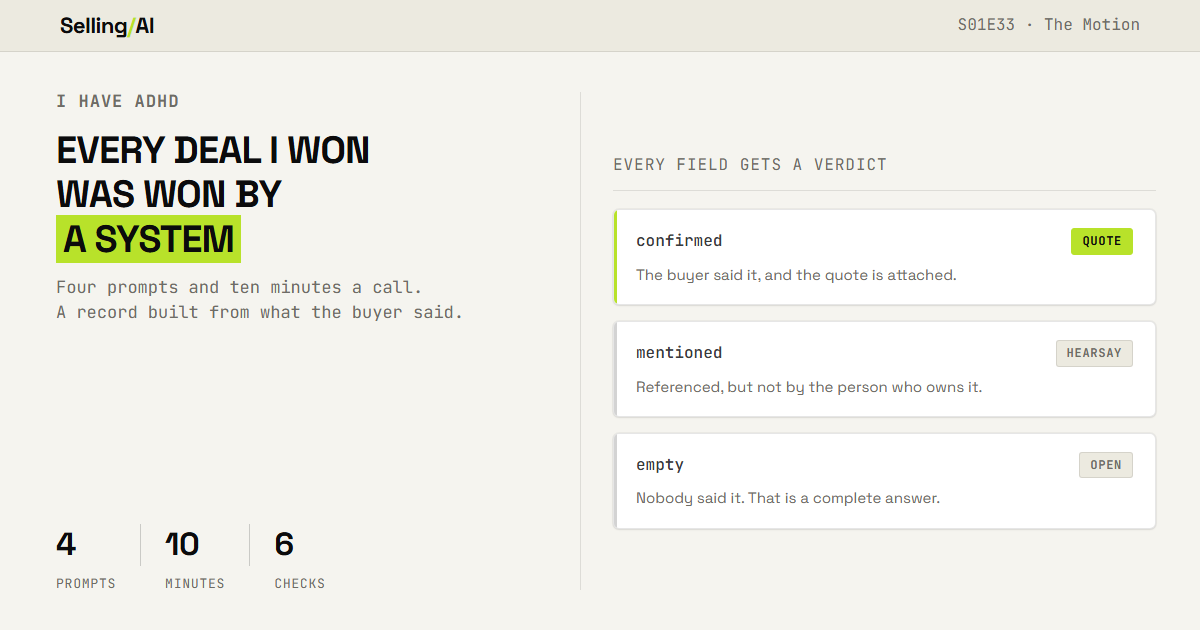
- STATUS: CONFIRMED (a buyer quote supports it), MENTIONED (referenced but not confirmed by the person who owns it), or EMPTY
- The supporting quote and its timestamp, if there is one
- If EMPTY, the one question that would fill it, phrased the way I would actually ask it on a call Rules: - EMPTY is a correct and complete answer. Do not infer, do not extrapolate from industry norms, do not use my prior notes as evidence.
- A thing my champion said about someone else is MENTIONED, never CONFIRMED. Budget is confirmed by whoever owns budget, and by nobody else.
- Do not score or grade the deal. I am not asking how it looks.
- End with a list of every EMPTY element, in the order I should close them.
The empty fields are the output. Everything else is bookkeeping.
Most tools that do this will happily fill in all eight, because a complete scorecard looks like a working deal and nobody wants to hand their manager a page of blanks. A full scorecard built from four real quotes and four confident guesses is worse than an honest half empty one, because you have lost the ability to tell which half is which. Blanks are not a failure state. Blanks are next weeks call plan.
Step 3: Put It Where the Deal Lives (3 minutes)
Now it goes into the record, and the follow up goes out. Same source material, two destinations, and both happen before you stand up.
Here is the qualification output from this call: [PASTE THE OUTPUT FROM STEP 2] Produce two things. FIRST, the CRM update. A short block I can paste straight into the deal, with: - Each CONFIRMED element and the quote behind it
- Each EMPTY element, listed plainly as still open
- The next step, with a date and a named owner, only if the buyer actually agreed to one. If they did not, write "no next step agreed" instead of inventing one. SECOND, the follow up email to the buyer. Under 150 words. It restates what I heard them say, in their language, and asks them to correct anything I got wrong. No pitch, no recap of my product, no enthusiasm. Rules:
- Nothing appears in either output that was not in the input.
- If the next step is missing, say so in both. Do not smooth over it.
The follow up is the part most reps already do. The record update is the part that gets pushed to later, and later is the reconstruction business we just spent this whole issue trying to get out of.
Theres a second thing the email is doing. You are sending the buyer a written version of what you believe, and if they dont correct it, you now have that in writing. Your record stops being what you heard and becomes what they didnt dispute. Thats a materially stronger thing to walk into a forecast call holding.
Step 4: Let Something Else Check Your Work (0 minutes)
Three steps in and I have to admit the obvious problem. All three of them still need me.
They need me to remember to run them, after every call, on every deal, forever, including the Friday with four calls back to back. Thats a rule, and we already covered what a rule needs.
So the last step is the one that runs whether I show up or not. Six checks, across the whole pipeline, on a schedule:
a deal with no close date
a close date already in the past
a deal with no owner
a deal with no amount
a deal with no next step
a deal that hasnt moved in 30 days
You can run those by hand against an export.

Here is an export of my open pipeline: [PASTE CSV OR TABLE] Flag every deal that fails any of these six checks: 1. No close date
2. Close date is in the past
3. No owner
4. No amount
5. No next step
6. No activity in the last 30 days Return a table: deal, which checks it failed, and the amount at stake. Sort by amount, largest first. Give me the total dollar value of everything flagged, and state it separately from my total pipeline. Do not suggest fixes. I only want to know what is wrong.
Thats the point where I stopped writing prompts and started writing software.
A special offer for HubSpot users:
Its called CleanPipe, and it does step four and nothing else.
It connects to HubSpot, reads your open deals on a schedule, and emails you the ones that failed those six checks, with the dollar value attached so you can see what the mess is actually worth. It never writes anything back. It cant, because it doesnt have permission to… and that was on purpose. Something that only reads can never quietly make your record worse while telling you its helping.
Its $49 a month, and Im not selling it to you today.
Ive been running it against my own pipeline, which is close to useless as a test. I already know where my records are bad.
I’m opening 10 beta seats. Free through the beta, and free for an additional 365 days. Thats a trade rather than a discount. My half is the software plus direct access to me for anything you want changed. Your half is one reply after two weeks: one thing it caught, and one thing it missed.
The missed half is the part I actually need. Six checks is where I started, not where this should end up, and the only people who can tell me what rule seven is are the ones watching it run against a pipeline they care about.
If you want a seat, reply to this email with CLEANPIPE. I'll send the install link.
Why This Works
Four reasons.
Evidence outlives memory. A quote is exactly as true in November as it was the day it was said. Your impression of the call starts decaying the second you stand up, and by week six what you have left is a story you have told several times, which is a different thing from what happened. The record built out of quotes is the only one worth the same in week nine as it was in week one.
Blanks are information. A record that is allowed to be empty shows you exactly where the deal is thin. A record that has to be full shows you nothing, because once every field has something in it you have lost the ability to tell the four things you know from the four things you decided. Reps dont lack qualification data. They lack the ability to tell which of their qualification data is real.
The forecast stops being an argument. When every field has a quote behind it, that meeting turns into a reading rather than a defense. Youre not persuading anybody the deal is real. Youre showing them what the buyer said, and then everyone in the room is looking at the same thing, which is a considerably shorter meeting.
And the last one is the whole point. This works because it stops needing you. Not you being more organized, not you caring more, not you promising your manager youll be better about updating the CRM. The capture is attached to the call instead of to your intentions, which means it survives the week with four calls on Friday and a flight on Monday. Thats the only kind of system that holds, and I know that because Im not capable of running the other kind.
Rep Action this week
Run the six checks against a pipeline export. One export, four minutes, you can do it before your next meeting.
Write down the number, not the list. The dollar total of everything that got flagged. Thats the portion of your pipeline that is currently a guess, and it is almost always bigger than people expect.
Then take one call this week, any call, and run steps one through three on it before you stand up from the desk. One call. Not all of them, and not retroactively across the last three weeks, because that version never gets done and you know it.
By Friday you have two things you didnt have Monday. A number, and one deal whose record is made entirely of things somebody actually said out loud. The number is the one that gets your attention. The deal is the one that compounds.
The four prompts above are how you learn this. Running it against a book you already let get away from you is a different problem, and thats whats below.
This week in the Vault:
The Close-Out. All four steps as one prompt, transcript in and record block out, for once you know the sequence and just want it done before you stand up.
The Backfill. For the deals already sitting in your pipeline that were written from memory, it marks every field as evidenced or unsupported so you find out which parts of your current forecast are real before someone else does.
The Call Plan. Turns the EMPTY fields into the actual questions for the next conversation, in the order that closes them fastest, so a half empty scorecard becomes an agenda instead of a worry.
Members get every Vault drop plus the full back library.
$15/mo, or $100/yr and save $80.
~ Jay
Click here for the stack I’d build today: https://www.sellingwithai.vip/stack

You just read the motion. Now run it.
The prompts, checklists, and templates that turn this into a 10-minute execution are in the Vault.
Vault access includes:
- Copy and paste execution prompt packs
- Deal, outbound, and follow-up playbooks
- Operating checklists for every motion
- Members Vault access
