Jun 28, 2026
by Jay Campbell
S01E25: Champion Enablement: Give Your Internal Advocate the Tools to Win
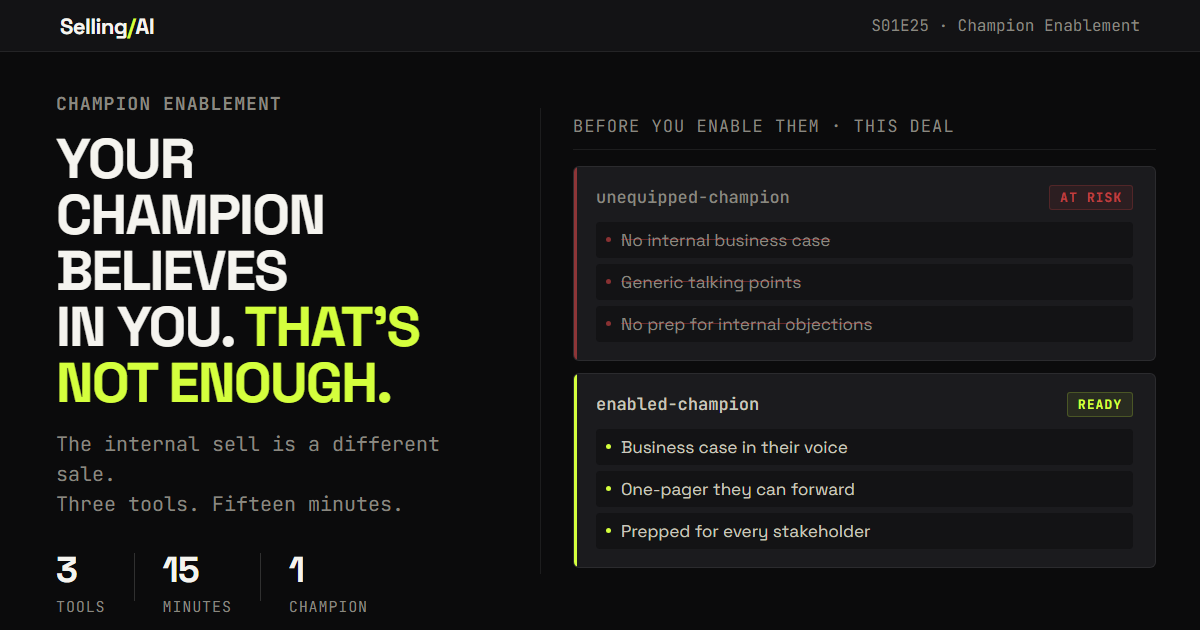
The short answer
Your champion is sold. That's not the problem. Here's a 3-step workflow to build the internal business case, forwardable one-pager, and objection prep your champion needs - in 15 minutes.
Lets begin
The discovery call went as expected. Next comes the demo. As you are walking through the platform, you can tell that your champion is completely invested. They're asking the right questions. They're engaged. Your champion is sold. That's not the problem.
The problem is what happens when they the demo ends. They schedule 30 minutes with their VP. They open with the pain point. The VP asks two questions they didn't expect. The follow-up they promised you never comes. You send a check-in. They say they're "still working through internal alignment." Two weeks later, the deal slips.
You did everything right externally. The deal died inside the account.
Most reps diagnose this as a closing problem and push harder. The actual gap is earlier, and it belongs to you. Your champion walked into that room without the right tools. Nobody gave them to him.
The internal sell is a different sale. The person doing it is not a sales professional. That combination is why late-stage deals collapse with no warning.
Why the Internal Sell Fails
Your champion has been on every single call. They've seen the demo. They've heard you handle every objection. None of that transfers to a room with their CFO.
Because when they walk in there, they're not selling a product. They're selling a prioritization decision. "We should spend budget on this, now, over the five other things competing for your attention." That requires a financial frame. It requires speaking in the language of outcomes their leadership cares about. It requires handling a "why now" from someone who was never in your calls and has no reason to feel urgency.
Your champion is a subject matter expert on the problem. They are not equipped to frame the solution the way an economic buyer needs to hear it. That gap is yours to close.
Most reps hand their champion a demo recording and call it enablement.
Three Tools. Fifteen Minutes.
Build these before the champion's next internal meeting.

Step 1: The Internal Business Case (5 minutes)
The business case your champion needs is not the ROI deck you built for your sales process. That document positions your product. It has your logo on it. Nobody forwards that to their CFO.
What your champion needs is a business case written as if they authored it. The problem framed in terms their leadership cares about. The cost of doing nothing. The outcome the organization is buying.
Use this prompt:
My champion at [COMPANY] is [TITLE]. They are building internal support to move forward with [CATEGORY/SOLUTION]. Their economic buyer is [ECONOMIC BUYER TITLE]. Here is what I know about their situation: [PASTE YOUR DISCOVERY NOTES / CALL TRANSCRIPTS / DEAL SUMMARY] Write an internal business case from the champion's perspective, not the vendor's. It should: 1. Frame the problem in terms that land with [ECONOMIC BUYER TITLE] — not in product terms
2. Quantify the cost of inaction where possible (time, revenue, headcount, risk)
3. State the expected outcome in business language, not feature language
4. Include a "why now" rationale tied to something real in their business context
5. Stay under 300 words — this is a verbal talking track, not a document Do not mention [YOUR COMPANY NAME] by name more than once. The champion is the author. Write as if this is their independent point of view.
The instruction to limit mentions of your company is the most important line in that prompt.
An internal business case that reads like a vendor pitch gets forwarded to procurement. It needs to sound like the champion arrived at this conclusion on their own.
What comes back is a talking track. A few paragraphs your champion can internalize and deliver in their own words. It will be sharper than anything they'd write themselves, and it will land because it sounds like them.
Step 2: The One-Pager They Can Forward (5 minutes)

A one-pager is not a summary of your pitch deck. It exists to do one thing: help your champion get a meeting with the next stakeholder.
Most reps either don't provide one or they provide a product sheet. Product sheets are built for buyers who found you on G2. They are not built for an internal budget conversation with someone who has never heard of you and did not ask to be in this process.
Use this prompt:
Write a one-page internal document my champion can forward to [ECONOMIC BUYER TITLE] to request a 20-minute conversation. Context: Company: [COMPANY] Champion: [CHAMPION TITLE] Economic Buyer: [ECONOMIC BUYER TITLE] The problem being solved: [1-2 sentences from your discovery notes] What success looks like in their words: [What the champion told you] Urgency or timing factor: [If any — if none, say so] The document should: - Be written as if the champion authored it, not the vendor
- Open with the business problem, not the solution
- State clearly what the champion is asking for (a 20-minute call, a review, a decision)
- Include one number or metric if there is a credible one from their context
- Fit on a single page — under 250 words Do not use sales language. Do not include pricing. Do not mention competitors. Also write the two-sentence email they send when forwarding this, with a subject line.
That last line matters. The forwarding email is often what gets read first. If the subject line sounds like a vendor introduction, the document never gets opened.
Step 3: Internal Objection Prep (5 minutes)

The objections your champion will face inside the organization are not the ones you've been handling on calls.
You've handled pricing questions and product comparisons. Your champion is going to face budget prioritization ("we have five other things this quarter"), IT skepticism ("we need to evaluate this properly before anything gets deployed"), risk aversion ("what happens if this doesn't deliver"), and the status quo defender ("nothing is broken enough to justify this").
Most champions get blindsided because no one told them those questions were coming.
Use this prompt:
My champion at [COMPANY] is building internal support for [CATEGORY/SOLUTION]. They will have conversations with these stakeholders: [LIST THE ROLES] For each role: 1. Name the most likely objection or concern that role will raise
2. Write a 2-3 sentence response the champion can use
3. Suggest one question the champion should ask to move the conversation forward rather than defend the decision The responses should sound like a thoughtful internal colleague, not a vendor script. Do not use sales language. The champion is not selling - they are advocating.
What comes back is a preparation framework. Your champion reads through it before the meeting, sees the questions they'll face before they face them, and walks in with answers instead of hoping they don't get asked.
The difference between a champion who is prepped and one who isn't is visible in the first two minutes. The prepped champion addresses concerns before they become objections. The unprepped champion gets defensive when pushed.
Why This Works
These three tools address three distinct failure modes in the internal sell.
The business case fails when it reads like a vendor pitch. The champion sounds like they're selling you, not advocating for a decision. The prompt fixes that by centering the champion as the author and limiting direct product references.
The outreach fails when it asks for attention without earning it. A one-pager that opens with the business problem instead of the product description respects the economic buyer's position. They get to evaluate, not get sold.
The internal meeting fails when the champion runs out of answers. Objection prep doesn't script the conversation… it maps the terrain. A champion who has seen the questions before is a completely different advocate than one who hasn't.
Every one of these outputs can be built in five minutes. Most reps will never build them because the assumption is that a champion who believes in you will figure it out.
Sometimes they do. When they don't, you don't find out until the deal is already cold.
Rep Action this week
Pull your two most at-risk deals - the ones where you have a champion you trust but whose internal process you can't see.
For each one: run the business case prompt, then the one-pager prompt. Send both to your champion before their next internal conversation. Tell them to use what lands and drop what doesn't.
After that meeting, debrief. Ask them what questions came up that the materials didn't address. Feed the answers back into the prompts. Two iterations from now, the materials are built for your specific deal, your specific account, and your specific champion.
~ Jay
Everything above makes your champion a better messenger. Sometimes that's not enough.
Because the prompts can't fix the core problem: your champion still has to be in the room. The CFO reviews your ROI at 9pm on a Tuesday. The CISO who was never on a single call forms an opinion from a compliance doc or worse, outdated research online. The user who has a specific question about a feature not addressed. Your one-pager doesn't answer them and your champion may not be able to either. And with 83% of the buying process happening outside of interactions with sales, this problem is only growing. This is where understanding degrades and deals quietly slip.
ENaiBLD is the digital solution expert in the room when you can't be. It's a Buyer-Enabled Evaluation System - a sales-governed expert every stakeholder can ask anything, directly, on their own time. The CFO, the CISO, the skeptic: they get accurate, on-message answers, without your champion relaying them.
Here's the part reps care about. You don't just close the gap - you see into it. ENaiBLD captures every question, theme, and stakeholder, and surfaces the risks and objections forming while you're not there. You walk into the next meeting already knowing what each person cares about, and which concern(s) could quietly kill the deal.
Arm your champion. Then put an expert in every room you can't get to: enaibld.com

You just read the motion. Now run it.
The prompts, checklists, and templates that turn this into a 10-minute execution are in the Vault.
Vault access includes:
- Copy and paste execution prompt packs
- Deal, outbound, and follow-up playbooks
- Operating checklists for every motion
- Members Vault access
