Nov 17, 2026
by Jay Campbell
S01E46: One AI Writes the Email. Another AI Filters It.
The short answer
Buyers skim outreach for the ask. Three prompts to find your own tells, get the one line only you could write, and send a first message with no ask.

This Week in AI Sales
Businesses can now put their own AI agent inside ChatGPT. OpenAI's announcement on November 10th lets a business claim its profile and see how often ChatGPT mentions it. US ecommerce and online service businesses can also launch a Business Agent that answers people's questions right inside ChatGPT. So check whether your company has claimed its profile yet, and what it says about you. (A buyer's AI asking your company's AI the questions... hold that thought.)
Let's begin
Last Friday I posted about the job market on LinkedIn. There’s one part of my post that I keep coming back to…
candidates are using AI to apply to hundreds of jobs. companies are using AI to screen hundreds of candidates. so we built a hiring process where one bot writes the application... another bot rejects it... and no human is involved in the filtering process.
Jay Campbell

I ended it with "the system seems broken. what's the fix?" Now I’m using the same topic (how to stand out as human in a world of full of AI) for this week’s issue - because it truly does relate to the current state of outbound in 2026.
Reps are using AI to send hundreds of emails. Buyers are using filters (and more and more, their own AI) to screen hundreds of emails. So one bot writes the email... another one filters it out... and no human is involved in the filtering process.
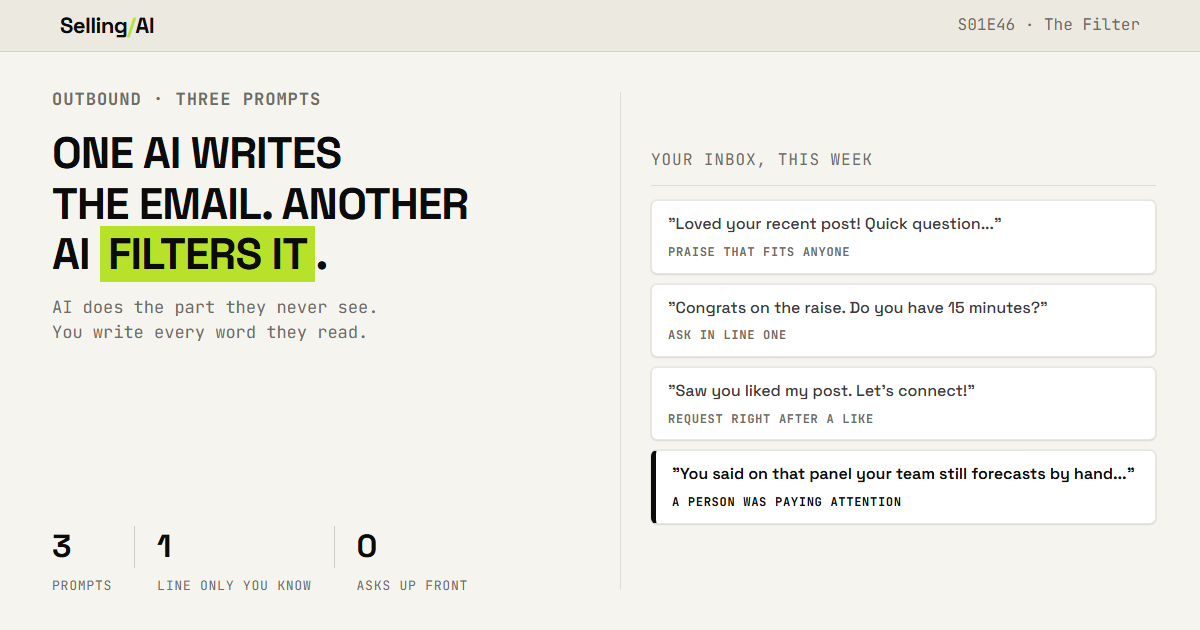
Think about your own inbox this week. The DM that opened with a compliment about your profile. The connect request with a little note on it. The email that knew your company just raised. The voicemail from a number you didnt recognize. How many of those did you answer?
We all do this now. We assume the next message is a bot or a pitch, so we skip it, and most of the time we're right. But the filter cant tell who's real either... and when you're the one doing outbound, you're the one getting skipped.
So this one is for anybody whose job includes reaching people who didnt ask to hear from them. I think most buyers now read a message to figure out what the sender wants from them, before they ever decide whether it's any good. This week is my best answer so far to my own question.
Why a Better Message Fails
You've probably felt this one. You like someone's post, and a day later there's a connect request. You accept it, and a day after that there's a DM. Then the DM has a calendar link in it.
People have seen that sequence so many times that they've started skipping the first step. They read a post and dont like it, because a like is usually what sets off the connect request. They leave the request sitting there, because accepting it is what sets off the DM. They let the unknown number go to voicemail, because that's where the pitch is. (I think that's a big part of why connect requests seem so much harder to get accepted lately.)
So a better message doesnt help as much as it used to, because a better message is still the first step in that sequence. S01E26 was about writing from a real signal, and S01E37 was about saying you're guessing instead of sounding sure. I still think both are right. They make a better first step... and right now a lot of people are trying hard to never be on the receiving end of a first step at all.
And buyers are saying it out loud. In Gartner's survey of 646 B2B buyers, taken in August and September 2025, 67% said they'd prefer to buy without a rep at all. A year earlier, Gartner's number was 61%. And 45% of those buyers had already used AI during a recent purchase. So the person on the other end of your sequence is running a filter, and more and more often there's an AI in it too.
And nobody in this is the bad guy. The SDR sending a pile of emails a day is trying to hit a number somebody else set. The ops person who built the sequence is trying to make that number possible. The buyer ignoring all of it is protecting their afternoon. Everybody is doing something reasonable, and together it adds up to a world where a real person has a hard time getting through.
Which is the question I actually wanted to ask in that post: how do humans reach humans when AI is doing so much of the talking?
Prove a Person Sent It
If people read for motive first, the message has to answer that before they go looking: a real person sent this, they paid attention, and they dont want anything from me yet.
You cant just say that, of course. "I'm a real person" is exactly what a bot would write. So you have to show it, and here's how I'm splitting the work: AI does the part the other person never sees, and you write every word they read.
Three steps, no new tools.

Step 1: Your Tells List
You get pitched every week too, which means you already know the tells. You just havent written them down.
Go back through the last week and pick 10 messages you ignored: DMs, connect notes, emails, voicemail transcripts, whatever you've got. Copy just the first line or two of each, and take out names and companies.
Here are the first lines of 10 messages I ignored this week. Names and companies are removed. [PASTE THEM, NUMBERED 1 TO 10] For each one, tell me what made it read like a bot, or like someone who wanted something from me. Point to the exact words or the move, not the topic. For example: an ask in the first sentence, praise that could fit anyone, a detail anyone could look up, a question that is really a pitch, a request that came right after I liked something. Then give me my tells list: the 5 tells that showed up most, in plain words, most common first, each with how many of the 10 it showed up in. Do not rewrite any of the messages. Do not tell me which ones to answer.Then go back through your 10 and mark any that turned out to be a real person with a real reason. Those are the ones the filter cost you... and if you find one, answer it. Staying reachable is the other half of this.
Step 2: The Line Only You Could Write
Look at your tells list and you'll probably notice something: almost every tell is something anybody could have written. A compliment that fits anyone. A detail from a profile. The funding round. AI can find all of that in a few seconds, so none of it proves anybody paid attention. (That was S01E26's point too.)
What AI cant find is what's only in your head. What you really think about the thing they posted. What you've seen at companies like theirs. Something they said to you, if you've ever talked. The question you actually want them to answer.
So in this step, the AI doesnt write anything. It interviews you.
I want to reach out to [WHO, IN ONE LINE. For example: a VP of Sales at a company on my list, a buyer I met once at a conference, a former customer who changed jobs]. Why I'm reaching out, honestly: [ONE LINE. If you want something from them, say what.] Do not write the message. Interview me instead. Ask me five questions, one at a time, and wait for my answer before you ask the next one. Ask about things only I would know: what I actually think about what they have posted or said, what I've seen at companies like theirs, anything they've said to me, what I want to learn from them, and anything I noticed that is not on the internet. Never suggest an answer. If my answer could have come from their profile or a search, tell me, and ask again. After my fifth answer, give me back one line in my own words: the most specific thing I said that nobody else could have known. Change as few of my words as you can.The line it hands back came out of your head, not out of a search. I think people can feel that difference, even when they couldnt tell you why.
Step 3: The Message With No Ask
Now write the message yourself. Keep it short, put your line from Step 2 in it, and leave the ask out of this first one.
That last part probably feels wrong. I get it, you have a number. But I think the ask is the thing everyone is scanning for, so a first message without one is the one they can actually read. (If you do want something, Step 2 already had you say what. Say it plainly in your second message, once they've answered.)
Then check it against your own filter:
Here is my tells list, the things that make me ignore a message: [PASTE YOUR TELLS LIST FROM STEP 1] Here is a message I wrote: [PASTE YOUR MESSAGE] Check my message against my tells list, line by line. Quote each line that has a tell and name the tell. Also flag any ask, any line that could have been written without knowing this person, and anything longer than it needs to be. Do not rewrite my message and do not suggest new wording. I will fix it myself.Fix what it flags, in your own words, and send it.
Why This Works
It answers the motive question before they ask it. If people are reading for what you want, a first message with no ask doesnt give them anything to look out for. They get to read it as a message.
It carries something no tool could have found. Their funding round is one search away for anybody. What you've seen at companies like theirs isnt.
It checks your message against a reader you actually know. Your tells list came from what you ignored, so you're testing against the one filter you can see from the inside: yours. Your tells and theirs wont match perfectly. You're still a lot closer to them than any checklist somebody else wrote.
What I havent figured out yet. I dont have the fix. This is my best answer so far, and I havent measured it. I thought about comparing my own LinkedIn numbers from before and after, but the way I use LinkedIn has changed too much for that to mean anything. And if you have a number to hit this month, a first message with no ask is going to feel slow. I think it's still faster than a message nobody reads... but I havent proved that yet. Thats what the Rep Action is for.
Rep Action this week
Pick five people on your prospect list who post on LinkedIn. Read what they posted this week, and leave a real comment on each one: what you think, or a question you actually want answered.
Then leave it there. Dont send a connect request, a DM or a sequence step.
The number I want: how many of the five engage back within seven days. A reply, a like, a request... anything counts. Hit reply with that number. And if something else has worked for you, tell me that too. That was the question in my post, and I'm still collecting answers.
~ Jay
The free section gets you one real first message. The First Touch Kit does it for a whole list, helps with what to send once they answer, and checks the sequence you're already running.
This week in the Vault:
The Ten-Account Interview. One sitting, ten accounts: the AI asks you about each one and hands back a line per account, in your words.
The Second Message. What to send once they engage back (and what to do when all they did was like something), with a prompt that checks your ask before it goes.
The Sequence Tells Audit. Paste the sequence you're already running and see which steps read like a bot, one step at a time.
Members get every Vault drop plus the full back library. $20/mo, or $140/yr and save $100.
Click here for the stack I’d build today: https://www.sellingwithai.vip/stack


You just read the motion. Now run it.
The prompts, checklists, and templates that turn this into a 10-minute execution are in the Vault.
Vault access includes:
- Copy and paste execution prompt packs
- Deal, outbound, and follow-up playbooks
- Operating checklists for every motion
- Members Vault access
