Sep 15, 2026
by Jay Campbell
S01E37: Cold Outreach: Confident vs. Hedged. A 12-Day Reply Rate Test
The short answer
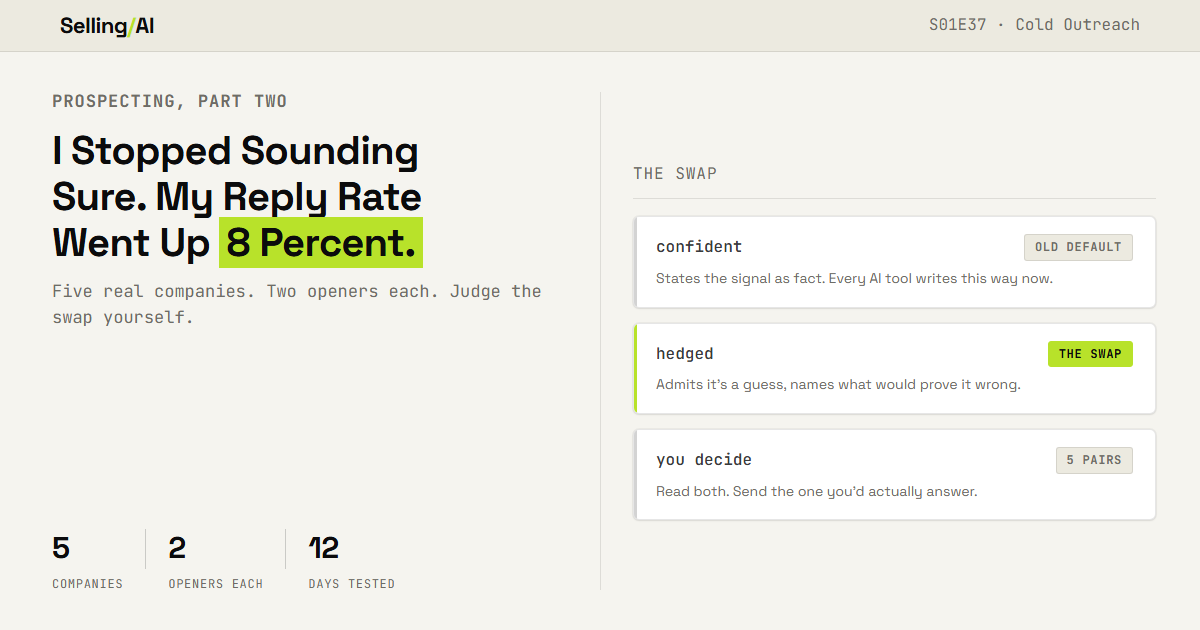
AI made confident, signal-based openers the default, and buyers can already read the pattern. I switched to honestly-hedged openers 12 days ago and reply rate rose 8 percent on a small sample. Five real companies, two openers each, judge the comparison yourself.
Previously, I told you to prospect on signals, not titles. Find a real trigger, then write from it with confidence. That's still true. But its also what every AI prospecting tool does now… by default, which means confidence itself just became the newest automation tell.
So this issue argues the opposite. Five real companies, two openers each. One states its reason like it's certain. One says it's guessing and asks instead of asserts. Read both before you decide which one you'd actually reply to.
i have not ran this through real testing (no A/B testing performed). But as I’ve noticed that more and more of the outbound sequences are all running from the same prompt, I decided to change my approach in my own outbound, and while I only have a small sample size - the results have been hard to overlook.
Why Confident Openers Stopped Working
A confident opener asserts a reason and moves straight to the ask. "You just raised at a higher valuation, so I know you're scaling fast, let's talk." That type of messaging used to signal research… that you actually did your homework… Now it's the exact format every AI prospecting tool outputs by default, because "sound certain" is what a model does when you ask it to generate an email based on signals (though, one could argue that AI models are confidently incorrect way more often than we’d like).
Buyers have read enough of these “personalized” outreach messages to recognize the template before the first sentence has been completed. The confidence isn't proof of research anymore. It's proof of a template.
And for those who have caught on (nearly everyone, by now), this type of templated, hyper-personalized email automatically registers as AI slop. Every AI prospecting assistant, when you ask it to write from a signal, defaults to the same three moves: state the trigger as fact, connect it to a business need in one confident clause, pivot straight to a meeting ask. That's not a flaw in any one tool, it's the shape the training data rewards, because a hedge reads as an incomplete answer and a confident answer reads as a complete one. The tools are optimized to sound finished. Finished is exactly what a buyer has learned to distrust.
Say You're Guessing. Ask Instead of Assert.
A hedged opener names the same signal, states it as an inference instead of a fact, names what would prove it wrong, and asks a real question instead of pushing for a meeting.
This isn't an argument for hedging everything. If you have a fact you can point to directly, a line from a call, a quote from the prospect themselves, state it flat. Hedge the inference, not the fact. The failure this issue is about is attempting to dress up inference as fact, not being confident about something you actually know.
Three steps below. Then five real pairs, three here and two more in the Vault, so you can read the pattern across more than one account before you try it on your own.

Step 1: Find One Real, Checkable Signal
Same method as always: a funding round, a leadership change, an acquisition, a job posting tied to your problem. One signal, one sentence, and you should be able to point to exactly where you found it (this is often the most important part, but is widely overlooked).
The signal doesn't need to be exclusive. Everyone chasing the same funding announcement isn't the problem this issue is about, that's S01E26's problem to solve. This issue starts after you already have the signal. What you do with it once you have it, confident or hedged, is the only variable being tested here.
Step 2: Write It Twice
Try it out with this prompt:
Here's a real signal about [COMPANY]:
[THE SIGNAL, ONE SENTENCE] What I sell: [ONE SENTENCE] Write two versions of a cold opener using this signal. CONFIDENT VERSION: State the signal as fact, assert why it matters to them, move straight to the ask. Under 50 words. HEDGED VERSION: State the same signal as your best guess, name specifically what would prove the guess wrong, ask a real question instead of pushing to a meeting. Under 50 words.
Neither version should use "I noticed," "congrats on," or any line that could have been auto-generated without actually thinking about whether the guess could be wrong.
Here's what that produced for Airtable. Real signal: Bending Spoons agreed to acquire Airtable for $2.25 billion, announced August 2026.
Confident: "Saw Bending Spoons is acquiring Airtable. Whoever owns your tooling roadmap in the next six months is going to want a system that doesn't depend on headcount to keep the pipeline honest. Worth 15 minutes before that roadmap gets rewritten?"
Hedged: "Guessing here: an acquisition like the Bending Spoons deal usually means someone new ends up owning tooling decisions for a while. If that's true at Airtable right now, a 15 minute conversation might be useful. If ownership hasn't actually shifted yet, tell me and I'll check back in a few months."
Read both again. The confident one sounds like it did more homework. The hedged one is the only one that survives being wrong.
Step 3: Read Both as the Prospect, Not the Sender
Read both versions of the opener again.
If a stranger sent you the CONFIDENT version cold, would you reply?
If a stranger sent you the HEDGED version cold, would you reply?
If you can't honestly say yes to the confident one, don't send it just
because it sounds more finished.
That's the whole test. Not a framework, a gut check you run on your own draft before it leaves your outbox.
Why This Works
The confident version has one failure mode: being wrong while sounding certain. If Airtable's ownership hasn't actually shifted decision-making yet, that message reads as a stranger who guessed and got it wrong, out loud. The hedged version has almost no failure mode, it already told the reader it might be wrong, and asked them to correct it. Being corrected by a prospect is a reply. Being caught overconfident by one will honestly get you moved to the spam folder.
The objection is obvious: doesn't hedging just sound weak? Not if the guess itself is still sharp. A weak message hedges on the point, "I thought this might be relevant." A hedged message in this framework commits to a specific, falsifiable claim, it just admits the claim is a guess instead of dressing it up as research. The confidence is in the specificity, not in the certainty. That's the part most reps skip when they try this and it falls flat, they soften the claim instead of softening only the certainty around it.
Two more real pairs, same method. Ramp raised at a $44 billion valuation in June 2026, then opened talks for $60 billion in September, three months later.
Confident: "You're raising again at $60 billion, three months after $44 billion. That pace means your GTM team is scaling faster than your systems can track it. Let's talk about keeping pipeline data honest at that speed."
Hedged: "Guessing here: going from a $44 billion round to talking about $60 billion three months later usually means headcount and process are both stretching fast. If that's true on your revenue team specifically, pipeline visibility is probably getting harder to trust. If I'm wrong about where the strain actually is, I'd rather know than guess again."
Canva was marked down 17 percent to $34.9 billion in August 2026, alongside a lowered revenue growth forecast.
Confident: "Saw the markdown and the lowered guidance. Budget scrutiny on tools is probably up right now, and I can show you where you're overpaying for coverage you don't use."
Hedged: "Guessing here: a markdown and a lowered growth forecast usually means tool spend gets a harder look than it did a year ago. If that's true on your team right now, there's probably room to consolidate. If spend scrutiny hasn't actually reached your team yet, this can wait."
Same pattern each time. The confident version reads like a headline turned into a pitch. The hedged version reads like a person thinking out loud, and it's the version that leaves the most room for the prospect to be the one who's right.
There's a reason this holds across all three signal types above. A funding number, a markdown, an acquisition, each one is public and each one is easy for the prospect to fact-check in ten seconds. The confident version bets that your interpretation of the public fact is also correct. The hedged version only bets that the public fact is real, and lets the prospect own the interpretation. You're right about the fact either way. You're only sometimes right about what it means.
I mentioned earlier that I have been testing this, albeit with a very small sample size. I “softened my approach” (asking instead of inferring) 12 days ago. In that time, my reply rate has increased 8 percent. I can only assume that it reads as more trustworthy., or more human. Whether that converts is a real test I'm running, and it's next issue's job to report back on, not this one's.
Here's what that test looks like, roughly: same list, split by account, confident copy on half, hedged on the other, tracked for two weeks. If the hedged half wins clean, that's next issue. If it doesn't, that's also next issue, and probably a more interesting one.
Which version would you actually answer if a stranger sent it to you cold? Reply and tell me. It decides whether next week is the real send-data test or a different angle entirely.
Rep Action this week
Pick 5 accounts already on your list. Not 50. Five.
For each one, find the one real signal you already have, then write both versions, confident and hedged. Read each pair as if you were the person receiving it.
Send the version you'd actually reply to. Not the one that sounds most like you did your homework, the one that would make you answer a stranger.
If both versions feel equally good to you, that's a sign the signal itself is weak, not that the framework failed. A strong signal makes the confident version feel a little too sure of itself. That discomfort is the whole point.
Three real pairs make the case. Five make it a pattern. The Vault has the other two, plus the batch version of the prompt and a scorecard for judging your own drafts fast.
This week in the Vault:
The Batch Two-Version Prompt. Runs the confident/hedged split across a whole list of accounts in one pass instead of one at a time.
Two More Real Pairs. Rippling and Vercel, same method, so you've seen the pattern hold across five different signal types before you trust it on your own account.
The Self-Judge Scorecard. Five questions that turn "would I reply to this" into a repeatable check instead of a gut feeling you have to redo every time.
Members get every Vault drop plus the full back library. $15/mo, or $100/yr and save $80. Upgrade here: https://www.sellingwithai.vip/upgrade
~ Jay
Click here for the stack I’d build today: https://www.sellingwithai.vip/stack

You just read the motion. Now run it.
The prompts, checklists, and templates that turn this into a 10-minute execution are in the Vault.
Vault access includes:
- Copy and paste execution prompt packs
- Deal, outbound, and follow-up playbooks
- Operating checklists for every motion
- Members Vault access
