Aug 4, 2026
by Jay Campbell
S01E31: The Best Sales Call You'll Make Today is a Breakup Call
The short answer
Most sellers and founders keep dead deals in their forecast because closing one feels like a loss. It's not. Here's how to tell a slow deal from a dead one, the three-part breakup call that actually closes it, and what to do when the call revives the deal instead. Prompts included.

In sales, we’re taught that relentless persistence is everything. Send another follow-up. Bump the email thread. Keep hope alive.
But the sellers who are winning understand something different… killing a dead deal is the win, not the loss.
Every minute spent still working a prospect who checked out three weeks ago is a minute you didn’t spend on someone who is ready to buy. E31 is here to help you close those dead files today.
You already know the signs. The calls that used to happen weekly stretch to every other week, then monthly. "Let me check with my team" turns into an email you never get a reply to. The champion who used to text back in an hour now takes three days, then a week. None of it reads as a no. It reads as busy, or slow, or bad timing. So you keep it open. You keep it in the forecast. You keep telling your manager “it's still alive."
It isn't moving. A deal that's gone quiet isn't paused. It's over, and the only question left is whether you're going to be the one to say so.
In my last role, I had a deal set to close in June. It kept getting pushed. The economic buyer went from excited to silent, and after two weeks of being ghosted, he finally responded to let me know he was now looking at the end of Q3, a full three months later. So I did what every other salesperson does. I pushed the close date out three months and stayed in touch.
Then he pushed to Q4. Then to Q1. The deal never closed. I spent a huge amount of time on that deal that could have gone to other deals already in my pipeline, or to building the pipeline I actually needed instead.
This matters even more if you're selling your own thing. A rep who keeps chasing a dead deal wastes their own time. A founder who keeps chasing one wastes the only time the business has — every hour spent on a maybe that was already a no is an hour not spent finding the buyer who was always going to say yes. Founders take longer to admit this than anyone, because turning down revenue feels irresponsible when the business needs it. It isn't. Revenue that isn't coming isn't revenue.
Here's how to actually tell the difference between a deal that's slow and one that's dead, and what to do the moment you know which one you're looking at.

Why "Still Moving" Is a Lie You Tell Yourself
Nobody decides to keep a dead deal alive. It happens by accumulation. Each individual choice — not calling it now, waiting one more week — feels reasonable in isolation. A deal doesn't die on a date you can point to. It fades, and fading is much easier to lie to yourself about than a clean no.
There's a real cost to admitting it, too. Closing a deal as lost means updating the forecast, means a harder conversation with your manager, means facing the fact that however many hours you spent on this one didn't produce anything. Keeping it open costs you nothing today. It only costs you the deal you're not working instead, and that cost never shows up on any report you have to look at.
That's the whole trap. The bad decision is invisible and free right now. The good decision is visible and requires you to say something out loud.
The Three Signals That Tell You It's Dead
A slow deal and a dead one can look identical from a distance — both quiet, both overdue for a next step. The difference isn't the silence. It's what's underneath it.
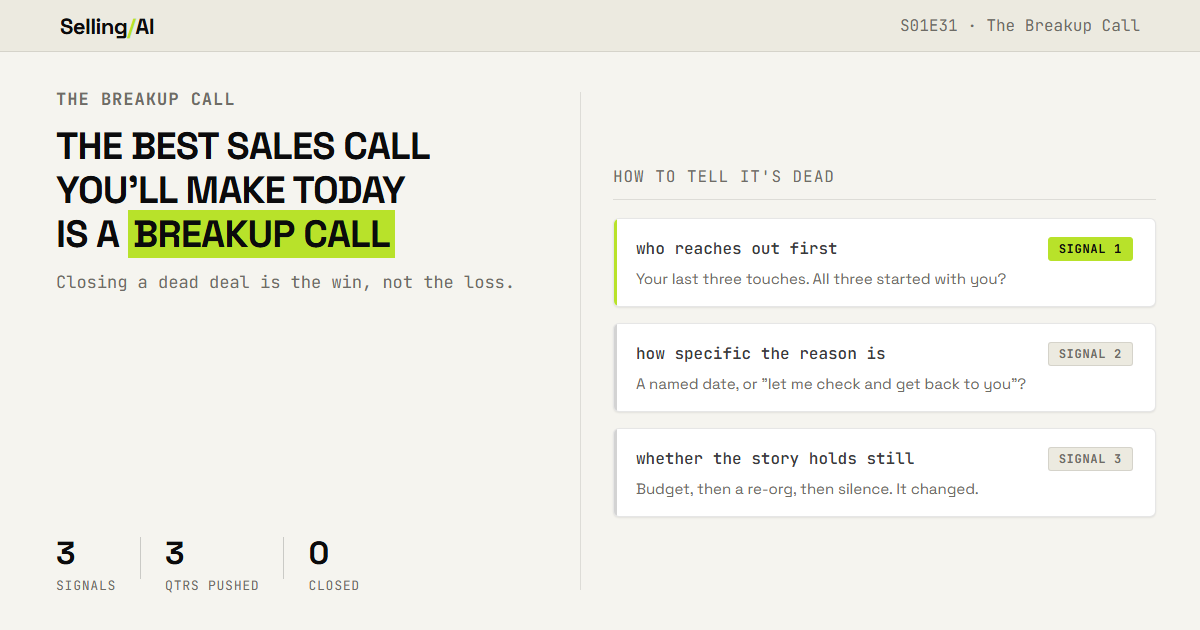
Signal 1: Who reaches out first. In a slow but real deal, your champion still initiates sometimes — a question, an update, even a small one. In a dead deal, you're always the one reaching out. Count your last three touches. If all three started with you, that's not a coincidence.
Signal 2: How specific the reason is. "We're waiting on the board meeting on the 14th" is a real reason. It's checkable, it has a date, you can plan around it. "Just been really busy" or "let me check and get back to you" isn't a reason. It's a placeholder for one, and placeholders don't resolve themselves.
Signal 3: Whether the story holds still. A real blocker stays the same until it's resolved. A dead deal's excuse changes. Budget becomes a re-org, which becomes "re-evaluating priorities for next quarter," which becomes silence. If the reason for the delay has changed more than once, the reason was never the real one.
Two or more of these pointing to dead means it's dead. Not probably. Not needs more nurturing. Dead.

The Dead Deal Scanner
You are a deal qualification analyst helping me decide whether a stalled deal is still real or already dead. Here are my notes on the deal's status, including recent contact history and any reasons given for delay: [PASTE YOUR NOTES] Score this deal on three signals: 1. WHO INITIATES: In the last three touches, who reached out first, me or them? 2. SPECIFICITY: Are the stated reasons for delay specific and checkable (a named date, a named blocker) or vague ("just busy," "let me check")? 3. STABILITY: Has the stated reason for delay stayed the same, or changed each time I've asked? For each signal, give a verdict (healthy / warning / dead) and the specific evidence from my notes that drove it. Then give me an OVERALL VERDICT: SLOW (real, keep working it) or DEAD (close it today), plus one sentence of reasoning. If the verdict is DEAD, do not hedge it. Tell me plainly. I'm asking this specifically because I already suspect the answer and need something less biased than my own hope to confirm it. Rules: - Be direct. Do not soften a dead verdict to spare my feelings. - A deal only gets a SLOW verdict if at least two of the three signals are healthy. - If I haven't given you enough detail on a signal, say so and ask. Don't guess.Making the Call
A breakup call isn't a trick to get a response. If you're doing it to manipulate someone into replying out of loss aversion, you're still playing the same game, just with better psychology. Do it because it's actually true.
Three parts, in order.

Say what you're seeing, plainly. Not an accusation. An observation. "We haven't been able to connect in a few weeks, and I want to check something with you directly instead of guessing."
Give them a real, easy exit. Most people avoid confrontation. Make it effortless to be honest with you. "If the timing's wrong, or this isn't a priority right now, just tell me. I'd genuinely rather know than keep guessing."
Close the file out loud. "I'm going to close this out on my end for now. If something changes, I'm one message away, but I don't want this sitting in either of our inboxes as an open question."
That's it. No pitch. No last-ditch value prop. The moment you try to sell inside a breakup call, you've turned honesty into a tactic, and most buyers can tell the difference.
Why This Works
Three reasons.
It replaces hope with information. A vague "still moving" gives you nothing to act on. A clear dead verdict gives you your afternoon back.
It's honest, which is rare enough to stand out. Most of what lands in a buyer's inbox is trying to get something from them. A message that asks for nothing, that just closes something out cleanly, reads differently — and occasionally it's the thing that gets a real reply, not because you tricked them, but because you were the first person who told them the truth.
It protects the deal you haven't found yet. Every hour spent narrating a story to your manager about a deal you don't believe in is an hour not spent on pipeline that's real. Closing the file isn't generosity toward the dead deal. It's protecting the live ones.
Getting Started
Pull up your pipeline. Find the deal you'd bet real money is already dead. Run the notes through the Dead Deal Scanner above. If it comes back dead, and you already knew it would, make the call today. Not the follow-up email. The call.
Then look at tomorrow's calendar and notice what you don't have to do anymore.
~ Jay
PS: That's the read on whether a deal is dead, and the call itself. For paid subscribers below: what to actually do when a breakup message revives the deal (it happens more than you'd think, and mishandling that moment kills a real opportunity), the founder-specific move for keeping dead deals from filling your pipeline in the first place, and a version of this you can bring to your own forecast call so a dead deal stops quietly weakening your numbers.
Click here for the stack I’d build today: https://www.sellingwithai.vip/stack

This week’s Vault includes:
Three more moves, all built on the same scanner above.
The revival test. What to do when a breakup message actually works and the deal replies — because the same hope that kept it alive for three quarters is just as ready to believe a fake yes as a real one.
The founder's filter. How to stop a dead deal from ever entering your pipeline in the first place, by checking whether you're saying yes to a real fit or to your own revenue fear.
The forecast you can defend. A version of the scanner that runs across your whole pipeline at once, so you walk into your next review already knowing which deals are dead instead of getting caught defending one.
You just read the motion. Now run it.
The prompts, checklists, and templates that turn this into a 10-minute execution are in the Vault.
Vault access includes:
- Copy and paste execution prompt packs
- Deal, outbound, and follow-up playbooks
- Operating checklists for every motion
- Members Vault access
