Aug 11, 2026
by Jay Campbell
S01E32: They Told You Exactly What to Demo. You Still Gave Them the Full Product Tour.
The short answer
The person who decides on your demo usually wasn't on your discovery call. Here's a 4-step, 15-minute framework for building the demo from the discovery transcript instead of the standard deck: list the room, pull the ask in their words, cut to it, and park the platform play. Prompts included.

The economic buyer was not on the discovery call. The discovery was a 1:1 call with the champion.
Twenty minutes into the demo, she turns to my champion and says “why are they showing us features we’re not interested in”
She didn't ask me. She asked my champion, who told me exactly what to show, and who was now sitting in front of his boss, who had just put it on him.
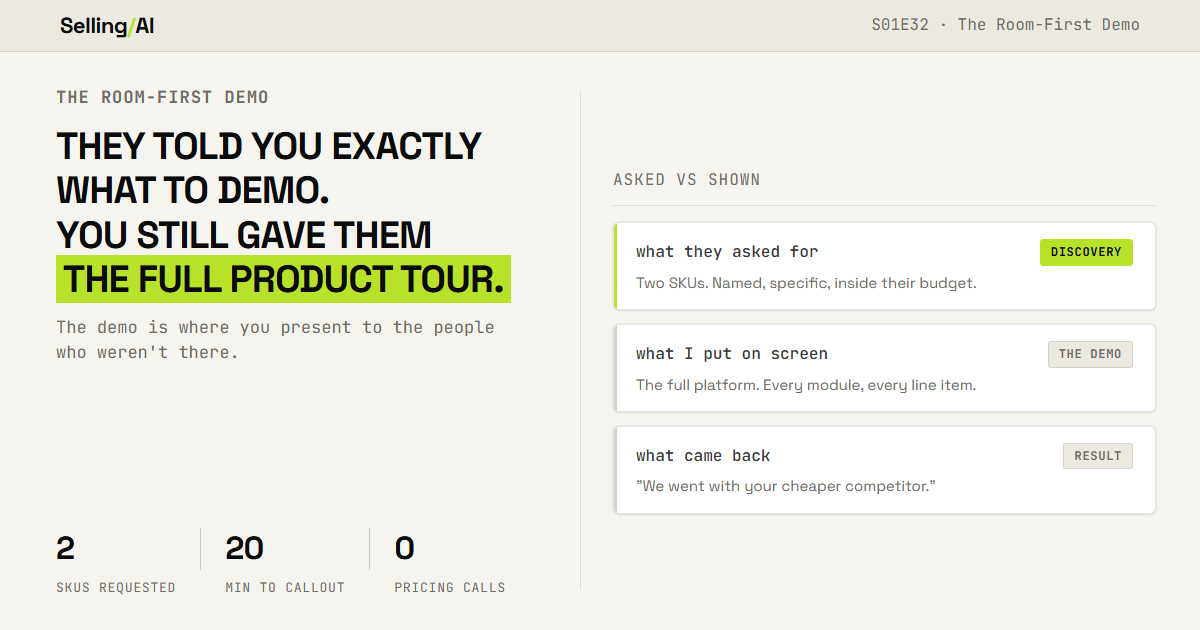
“Oh no - I am so sorry, this was all my doing”, I interjected before he had a chance to answer. I explained to her that her colleague had been clear with me about what they were shopping for and wanted to see in the demo. They asked to see two specific SKUs, and that showcasing our full platform was 100% my call, not his. I went on to explain my reasoning was that several of the pains they raised in discovery were solved completely by our entire platform and only partially by those two SKUs. The reasoning made so much sense to me. It was also irrelevant, because they had already told me they didn't want to spend that much.
As the call was nearing its end, I pushed for next steps and asked to get a pricing call on the calendar. They gave me the polite refusal:
Can you just send us your calendar link?
Them
I did, in fact, send that link, along with a recap of the call… the usual stuff. They did not, however, ever book that pricing call with me. The next email they responded to confirmed the deal was dead: we went with your cheaper competitor.
So why did I do it? Why show them more than they asked to see? Optimism, partly. Knowing what we sold would have had a real impact on how their team operated day to day. Knowing the product well enough to believe two SKUs solved half the problem and the full platform play solved all of it. And I was paid commission, which means the more you sell, the better you eat. That factors in too.
But the reason that matters for your next demo is a different one. If anyone had gone back and watched that discovery call, my demo would have made complete sense. But that call was me and the champion. He was the only person in that company who understood why the platform was on the screen, and he was not the one who needed to.
Often, your justification for what you show lives inside a call the decision maker never attended. The demo is where you present to the people who weren't there.
Every feature you show that nobody asked about is one more thing the buyer has to evaluate, question, and eventually say no to. When those features carry a price, and the buyer has already told you what they're willing to spend, it reads as tone deaf.
This gets worse if you're selling your own product. You built every feature in that deck. You know which ones took three months and which ones nobody else in the market has. So you show them, because they're good and because you're proud of them. The buyer sits there waiting for the two things they asked about.
Here's how to build the demo from the discovery call you already ran, for the people who are actually going to be in the room.

The Demo Is What Made Us Look Expensive
They didn't leave because a competitor had better features. They left because a competitor was cheaper, and I spent twenty minutes making the case that we cost more.
That's what the platform play does. Every screen the buyer didn't ask for reads as another line item. They had already told me what they were willing to spend. Everything past that number was evidence I hadn't been listening. I don't know what the competitor put on the screen. I know what I put on mine.
The uncomfortable part is that my read was right. Two SKUs did solve half the problem. The platform did solve all of it. Being right about the product is not the same as being right about the meeting.
The Demo Is Where You Present to People Who Weren't There
Discovery is where you earn context. The demo is where you find out that context doesnt always transfer.
Your champion sat through discovery. They know why you're showing what you're showing, because they told you to show it. Everyone else on that call is seeing your product for the first time, with no memory of the conversation that shaped it. The more senior they are, the less likely they attended, and the more likely they are to be the one who decides.
So the question that should drive your prep is not "what did I learn in discovery." It's "who is going to be in this room, and what does each of them already know."
The Room-First Demo

Four steps. Fifteen minutes of prep.
Step 1. List the room. Mark who was not on discovery.
Open the calendar invite. Write down every attendee, their title, and whether they were on the discovery call. That second column is the whole framework. Anyone in the "no" column has zero context with you, and their first impression of your company is about to be whatever you put on screen first.
If the most senior person in the room is in the "no" column, you are not giving a demo. You are giving a first meeting that happens to have a product in it.
Step 2. Pull the ask in their words.
Go back to the transcript and extract what they literally asked to see. Quoted, not paraphrased. "We spend four days a month reconciling" is an ask. "They'd probably get value from the reporting suite" is you talking.
This step is short and it's the one people skip. Your memory of discovery is already an interpretation, and the interpretation is where the platform play gets in.
Step 3. Cut to the ask, then order it for the person who wasn't there.
Default is exclusion. Every screen has to map to something quoted in step 2 or it comes out. Not "gets moved later." Out.
Then order what survives by the stated priority of the most senior attendee who missed discovery. Standard decks are ordered by how the product is built. Nobody in the room cares how the product is built. Lead with the thing the decider said out loud, and get to it in the first three minutes.
Step 4. Park the platform play.
This is the step that keeps you from overcorrecting into a demo that undersells you.
Your instinct to show more is often correct. The platform probably does solve more than two SKUs. The problem is the venue. A demo is where the buyer decides whether you listened. A pricing call is where they decide how much to spend. Expansion belongs in the second conversation, after they've agreed to the first one.
So write it down, put it on one slide at the end if you must, and say one sentence about it. "There are two other areas we could take this later. Happy to walk through those once we've got this piece sorted." Then move on.
I did the opposite. I made the expansion the demo, and I never got the pricing call where it would have belonged.
The Demo Cut List

You are a sales demo strategist. Your job is to decide what belongs in an upcoming demo and what does not. Here is the transcript or my notes from the discovery call: [PASTE DISCOVERY TRANSCRIPT OR NOTES] Here is who will be on the demo, with titles, and whether they were on the discovery call: [PASTE ATTENDEE LIST. Example: "Sarah Chen, CFO, NOT on discovery. Mike Torres, Controller, was on discovery."] Here is what I sell, including the specific products or SKUs available: [PASTE PRODUCT LIST] Do the following: 1. Extract every explicit request, stated pain, and success criterion from the discovery call. Quote their words. Do not paraphrase, and do not add anything they did not say. 2. Build a SHOW list. For each item: the capability to demo, the quoted ask it maps to, and which attendee raised it. 3. Build a CUT list. Everything else I could show that does not map to a quoted ask. For each one, name it and say what it would cost me to show it. 4. Order the SHOW list. Lead with the priority of the most senior attendee who was NOT on the discovery call. Assume that person has no context and the least patience in the room. 5. Flag anything on the SHOW list that only makes sense if you sat through discovery. Those need a one-sentence setup for the people who weren't there. Be strict. If an item does not map to something they actually said, it goes on the CUT list.This Week
Take the next demo on your calendar and run step 1 only. Write down who's attending and who was on discovery. If the decider is in the "no" column, you already know what to fix.
~ Jay
The framework above tells you what to cut. The Vault this week is about the person who made me cut it: the decision maker who was never on your discovery call and is about to judge your product in the first three minutes.
This week in the Vault:
The Cold Opener. The first three minutes for the senior person who missed discovery, written so they get oriented without your champion having to re-explain themselves in front of their boss.
The Platform Play Bridge. How to expand the deal without doing what I did. One line at the end of the demo, and the follow-up that earns the expansion conversation on the pricing call instead of blowing up the demo.
The Post-Demo Autopsy. A prompt that runs your demo against your discovery transcript and tells you what percentage of what you showed was actually asked for. It also catches the reverse mistake, which is the thing they asked for that you never got to.
Members get every Vault drop plus the full back library. $15/mo, or $100/yr and save $80. Get locked in at this rate before prices increase in October!
→ Upgrade here
Click here for the stack I’d build today: https://www.sellingwithai.vip/stack

You just read the motion. Now run it.
The prompts, checklists, and templates that turn this into a 10-minute execution are in the Vault.
Vault access includes:
- Copy and paste execution prompt packs
- Deal, outbound, and follow-up playbooks
- Operating checklists for every motion
- Members Vault access
