Jul 21, 2026
by Jay Campbell
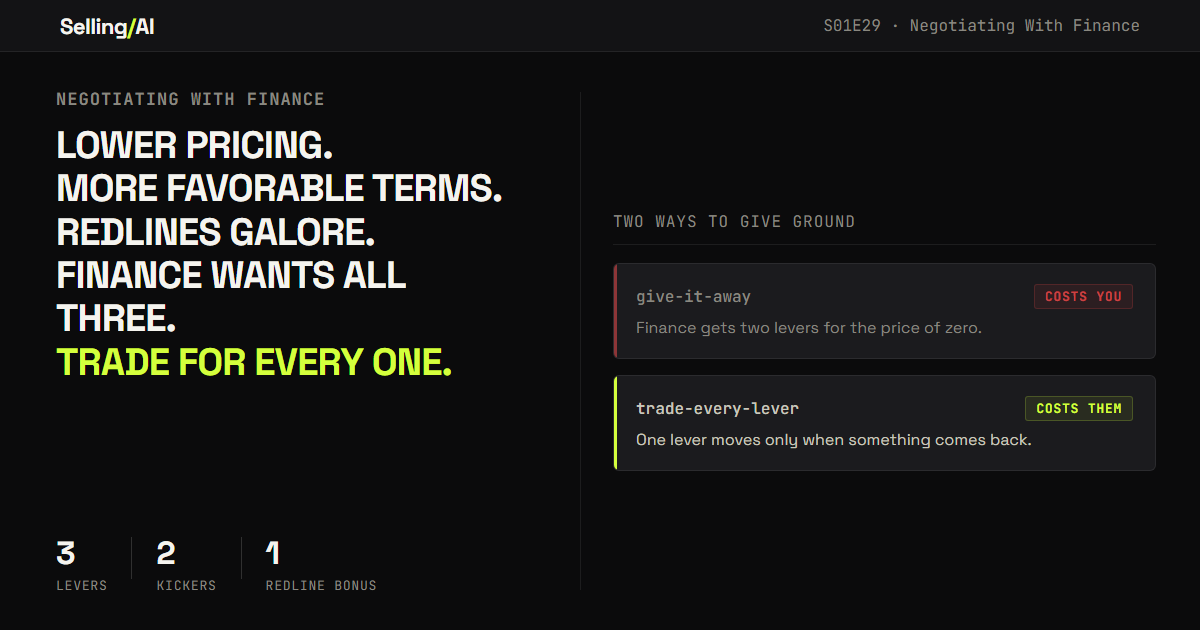
S01E29: Lower Pricing. More Favorable Terms. Redlines Galore. Finance Wants All Three. Trade for Every One
The short answer
Finance doesn't just negotiate price. They push on price, terms, and redlines in the same call, and most reps only have a defense ready for one of them. Here's a 3-part framework for trading every concession instead of giving it away, so nothing leaves the table for free. Prompts included.

The prospect finance team is joining today's call. And they didn't clear their calendar to talk about the product. They are joining to try to get a lower ARR. They are also going to push for more favorable (to them) terms to the contract… such as monthly billing (as opposed to quarterly, bi-annual, or annual). But it doesn't stop there… they might also ask for an opt-out clause… or maybe they are pushing for a 3 month contract, even though your company's minimum contract is 12 months.
I've been there. I remember a deal from about 6 months ago. During the pricing call, I built the ROI case. Walked them through the implementation timelines, what their ramp up would look like, and when the time to value (TTV) actually hits in their use case. Then we get to the pricing slides… more to come on that below.
By the final slide, three numbers were on the screen: price, billing terms, contract length. I already knew which two I needed to protect, because those were the two tied to my own payout, a two percent kicker for a multi-year term, another two percent for annual billing, on top of a twelve percent base commission on ARR. Price alone carried no kicker.
My main goal walking into that call wasn't to hold every number. It was to give them the feeling of a win.
So I opened the negotiation myself, before anyone asked. Five percent off list, no fight required, in exchange for a two year term with annual billing. Finance was on the call too, and five percent wasn't where they wanted to land. They pushed straight to twenty, and asked for bi-annual billing on top of it.
I scoffed. Told them there was no way I could get that approved. I could. Twenty percent was already pre-approved on every deal I ran, no manager sign-off required. But acting like it cost me something made the number mean something when I finally moved on it.
We landed at ten percent off list, a two year term, and a hybrid billing schedule, bi-annual for the first year, annual starting in year two. Double what I opened with on price, and more ground on billing than I'd planned to give.
So before the call ended, I asked for one more thing. A case study. They were a large, credible company, exactly the kind of logo that means something to a prospect who's still deciding. They said yes.
Got a verbal agreement on the call, and the deal closed a few days later.
Add up what actually moved. Price went five points further than I opened with. Billing gave up the first year to bi-annual instead of holding annual the whole way. Two levers, not one, more than I planned to give on either.
Contract length held exactly where I needed it. And I walked away with a case study from a company that makes my next ten cold calls easier just by being able to say their name. That case study doesn't stop paying out after this deal. It's still doing work on every call I open with it.
That call worked because of three numbers I'd already decided on before Finance said a word, and a rule I never broke: give one lever freely, trade for a second, never hand over all three. And when a trade costs more than planned, the return doesn't have to be one-time. It can keep paying out.
This is for anyone walking into a pricing call where Finance, procurement, or a buying committee is going to push on more than the number. Three moves make it repeatable: name every lever before you answer any of them, decide what you want back before you agree to anything, and trade every one instead of giving it away.
Why Reps Only Defend Price
Sales training spends most of its time on one number. Objection handling, discount ladders, walk-away points, all built around price. Nobody runs a training on holding a payment term or defending a contract length, so when Finance pushes on a lever besides price, the rep improvises. Improvising under pressure, with someone experienced at extracting concessions sitting across from you, goes one way almost every time.
Finance knows this. Their whole job is finding the levers nobody prepared for. Price gets the rep's full attention because it's the number on the forecast. The other levers get handled in the moment, quietly, because agreeing to them doesn't feel like losing. It feels like being easy to work with.
It isn't free to be easy to work with. It just doesn't get billed until the deal is already signed.
Trade Everything, Give Nothing
The fix isn't holding firmer on price. Most reps already hold price about as firm as they can. The fix is treating every other lever the exact same way: nothing moves without something coming back.

1. Name Every Lever Before You Answer Any of Them Don't respond to the first thing Finance asks for. Ask what else is on their list before you address any of it: "Before we get into numbers, what else are you hoping to lock down today, terms, timeline, contract language?" Most reps skip this and negotiate price first, then get hit with two more asks after they've already used their only prepared move. Get the full list up front and you're negotiating against reality instead of getting picked apart one item at a time.
2. Decide Your Trade Before You Agree to Theirs Before the call, for every concession you might make, decide what you'd want in exchange. A faster signature date. A longer contract term. A case study. An intro to another team. Removal of a redline you don't like. Decide this in advance, because improvising a fair trade in real time, under pressure, produces worse trades than deciding it in a calm room beforehand.
3. Never Concede Without Naming the Trade Out Loud When you do give something, say what you want back in the same sentence. "I can move on billing terms if we lock the contract at two years." Silent compliance reads as agreement, not as a trade. If you don't name what you want in the moment you give something up, you're not trading. You're just giving.
Why This Works
Finance isn't hostile. They're doing their job, which is finding every dollar and every lever that wasn't defended. A rep who names every lever up front removes the one thing that makes this work in Finance's favor: surprise.
Deciding trades in advance works because negotiating under pressure is where good judgment gets replaced by whatever gets the call to end faster. A trade you already decided on, before anyone asked you for anything, holds up. A trade you're inventing while someone's staring at you across a table doesn't.
And naming the trade out loud works because it turns a quiet concession into a visible exchange. Finance walks away from that call having gotten something. So do you.
Getting Started
Before your next pricing call, write down every lever you're willing to move and what you'd want for each one. Don't wait for Finance to ask. Decide it while nobody's asking you for anything yet.
On the call, ask what's on their list before you respond to any of it. And every time you give something up, say what you want back, in the same breath, every time.
~ Jay
PS: Everything above covers the three levers Finance pushes on before your contract ever reaches legal. It doesn't touch the fourth thing that shows up right after: the redline. For paid subscribers, below: a prompt for telling a real risk from a routine ask before you agree to either, a prompt for getting a fast answer out of your own legal team instead of a stalling "let me check," and a quick-reference menu for what to trade on the redlines that come up most.
Previous relevant issues:
S01E28: The Referral Engine: A Systematic Way to Turn Customers Into Advocates
S01E25: Champion Enablement: Give Your Internal Advocate the Tools to Win
S01E23: Multi-Threading Is a Mindset Problem, Not a Tactics Problem
S01E07: Your Buyer Doesn't Have a Buying Process. Build Them One
Click here for the stack I’d build today: https://www.sellingwithai.vip/stack

You just read the motion. Now run it.
The prompts, checklists, and templates that turn this into a 10-minute execution are in the Vault.
Vault access includes:
- Copy and paste execution prompt packs
- Deal, outbound, and follow-up playbooks
- Operating checklists for every motion
- Members Vault access
