May 17, 2026
by Jay Campbell
S01E19: The Main Branch Isn't a Document
The short answer
Build five context files so your AI stops sounding generic: buyer, product, objections, process, voice. Under 400 words each. Six checks before you load one.
Let's begin
Last week we set up the folder. Two branches. Nine empty files staring back at you.
If you followed through on the action, you should have something that looks like this sitting on your desktop right now:
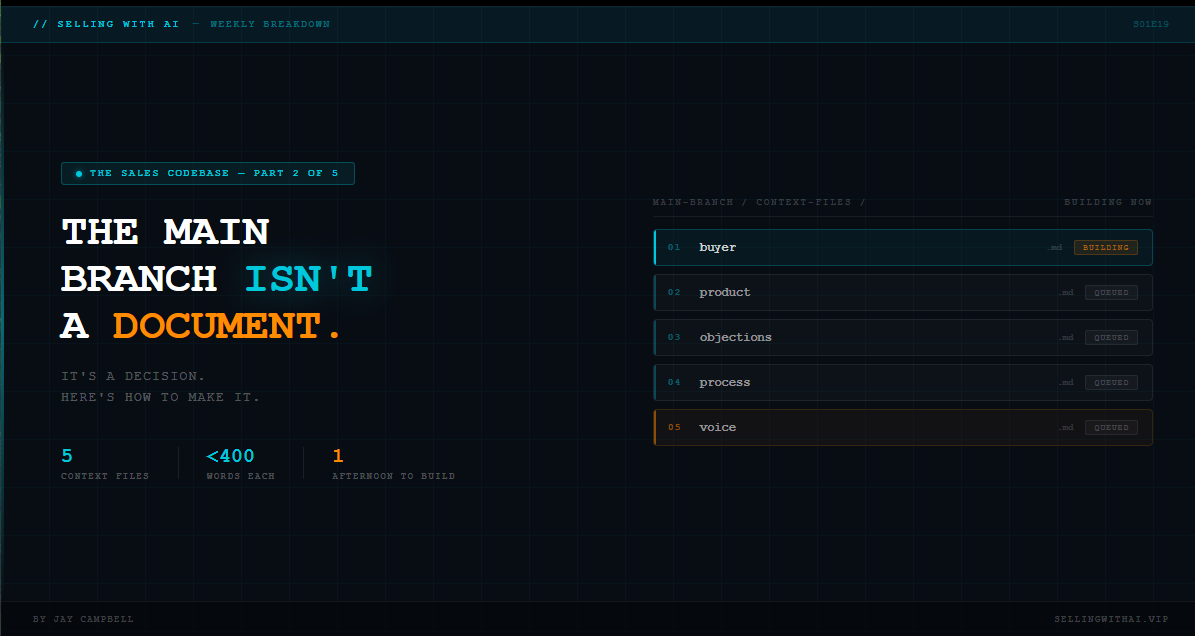
sales-codebase/ main-branch/ buyer.md product.md objections.md process.md voice.md personal-branch/ accounts.md voice.md deals.md territory.mdGood. Now we fill the first branch in.
But before you type a single word, I need to show you the mistake almost everyone makes when they build a context layer for the first time. Because if you don't see it up front, you'll spend an afternoon filling in five files that look complete, feel like progress, and do almost nothing when you actually use them.
The Context File That Wastes Your Time
The Problem With Context Files

Here's what useless context looks like. And I want you to read this carefully because I guarantee something this generic exists somewhere in your current setup.
"We sell to enterprise sales leaders who are looking to improve team performance and drive revenue growth across their organizations."
That is not a buyer profile. That is a description of every B2B sales tool on the market. Salesforce could have written it. Your top competitor could have written it. A tool you've never heard of could have written it.
When your AI reads that sentence, it has nothing to work with. It defaults to the most generic version of a sales leader it has ever been trained on and produces output that sounds exactly like that. Generic in, generic out. Every time.
Here's what usable context looks like:
"VP of Sales at B2B SaaS, 200-800 employees, Series B or C. Under board pressure on net new pipeline. Their reps aren't having enough first conversations. Not from lack of effort. They have no signal on who to call or when. 12 to 18 months into the role. Already burned one tool purchase that didn't land. They say 'pipeline coverage' on almost every call."
That's a real person. When your AI reads that, it has a human being to write to. The output becomes specific. It sounds like it came from someone who actually knows this buyer. Because now, it does.
The test is simple. Ask yourself: could this file describe your closest competitor? If the answer is yes, it's not ready.
Three Things That Make Context Actually Work

Every context file that works has three things. Most people include one.
1. Their exact words.
The phrases your buyers use on calls. Write them down verbatim. "We're drowning in manual work." "Ramp time is brutal." "I can't clone my best rep." When those phrases are in your context file, your AI uses them back. Output stops sounding like a brochure. And there is nothing sweeter than using their own words against them when they see your pricing for the first time.
2. Concrete specifics. Numbers. Titles. Company stages. Funding rounds. "Mid-market" is vague. "200 to 800 employee B2B SaaS, post product-market fit, third or fourth sales hire, no formal process yet" gives the AI something real to anchor to. Specific input produces specific output. Vague input produces brochure copy.
3. Honest negatives. Where you lose. Who you are not for. What your buyers actively tune out when you lead with it. Most people skip this entirely because it feels counterintuitive to write down your weaknesses. But it's what makes AI output stop sounding like a pitch deck. An AI that knows where you lose writes with credibility. An AI that only knows where you win writes like it's trying to close you.
Building buyer.md

Let's stop being theoretical. Open main-branch/buyer.md. Here's what you're putting in it.
Line one: titles and company profile. Not "enterprise sales leaders." VP Sales. Dir. of Sales Enablement. B2B SaaS. 200 to 800 employees. Series B or C. One line. Done.
Then write what actually keeps them up at night. Not "improving team performance." The real thing. Their reps don't have enough pipeline. The board wants an explanation every Monday. They inherited a team and inherited all the dysfunction that came with it. They already spent budget on a tool that the team never adopted. That failure is now part of the conversation every time a new vendor walks in.
Then write their exact words. Go pull your call recordings right now. What phrase shows up in almost every discovery call? Write it down exactly. Don't clean it up. Don't make it grammatically correct. Put it in the file the way they said it.
That's the whole file. Under 400 words. If you're writing more than that, you're not deciding what matters yet. Cut until you can't cut anymore without losing something essential.
One more thing: if you sell to more than one persona, build a separate file for each one. Do not mix them. Mixed context produces mixed output.
The Five Files and What Each One Actually Needs

Here is the complete spec for your Main Branch.
buyer.md — Start here, today. Titles and company profile. Real pain in their words. What they have already tried and why it failed. How they evaluate vendors. What makes them immediately stop paying attention. That last one is the hardest to write. It's also the most valuable.
product.md — Build this second. One sentence that describes what you do without using any jargon. Three specific wins you can actually prove. Where you lose and the real reason why. Two or three proof points that reliably move buyers. And the mistake reps most often make when they position it. If you write that last one honestly, this file will be worth more than your entire deck.
objections.md — This file is never finished. Start with the 8 to 10 objections you hear on every deal. For each one: the exact words they use, what they actually mean underneath it, and how you handle it. Not a scripted response. The intent and the direction. Update this file every month without exception. If nothing has changed in six months, you are not paying close enough attention to your deals.
process.md — Keep it short. Stage names. What has to be true before a deal moves forward. Where things stall and the real reason why. Who is in the room at each stage. This is a reference file, not a playbook. If you hit 400 words, you have not made the hard calls yet. Trim it down.
voice.md — Build this last, but do not skip it. Three words that describe how your team sounds. One real example of a message done right, with a note on what makes it work. One real example done wrong, with a note on why it fails. What phrases you never use. Pull actual examples from your best reps. Do not describe the voice in the abstract. Show it.
Five files. Under 400 words each. Under 2,000 words for your entire Main Branch. One afternoon to build it if you sit down and do it.
Before You Call Any File Done

Every file goes through six checks before it gets loaded into an AI session. If any one of them fails, the file is not done.
Could this describe your competitor? If yes, it is too generic. Add specifics until it can only describe you.
Does it use their words or your words? Find every piece of marketing language and rewrite it in plain speech.
Does it include at least one honest negative? Where you lose. What they don't care about. This is the most skipped check on the list. It is also the most important one.
Is it under 400 words? If not, cut it. Length is not quality. Length usually means you haven't decided what matters yet.
Would a new rep understand your buyer, your product, or your process after reading it once?
Does it include at least three phrases your buyers actually say? Not paraphrased. Verbatim. If not, go back to call recordings before you touch this file again.
All six pass: load it and run your next session.
Any fail: the failure tells you exactly what to fix.
Rep Action this week
Build buyer.md. That is the only file on your list this week.
Not product. Not objections. Buyer.
Get it through all six checks. Then load it into your AI and ask it to write a cold outreach email to the buyer you just described. Read what comes back. If it could have been written by anyone, the file is not specific enough. Keep cutting and sharpening until the output surprises you with how accurate it is.
That moment is the benchmark. Once you have it, the other four files will build themselves.

You just read the motion. Now run it.
The prompts, checklists, and templates that turn this into a 10-minute execution are in the Vault.
Vault access includes:
- Copy and paste execution prompt packs
- Deal, outbound, and follow-up playbooks
- Operating checklists for every motion
- Members Vault access
